The Human Induced Threat Reduction Model
Safety begins with awareness.
HITR is a practical framework for recognizing, assessing and responding to human-induced threats before a situation escalates. It was developed by Glen Morrison, CPP, from more than four decades in military policing, corporate security, executive protection, investigations and threat assessment.
Now available on Amazon
The HITR Mindset
Not about fear. About seeing clearly.
Most serious incidents don't begin with violence. They begin with people, with behaviour, and with small warning signs that go unnoticed or get dismissed as normal.
HITR helps you recognize those signs sooner, think through your options, and respond with confidence instead of hesitation. At home, at work, while travelling, or in a difficult conversation.
Fear causes hesitation. Preparation creates confidence.
How It Works
A decision-making cycle you can use anywhere.
At the centre of HITR is a simple, repeatable process. Situations change constantly, so assessment never stops.
Situation
Understand what is happening, who is involved and what has changed.
Assess
Gather information and evaluate the behaviour and the risk.
Plan
Identify your options, your resources and the likely consequences.
Act
Choose the most appropriate response and monitor how it works.
Reassess
Your action has changed the situation. Start the cycle again.
Every action creates a new situation.
Core Principles
Four principles at the heart of HITR.
Time + Distance = Options
The more time and space you have, the more choices you keep. Where you position yourself matters.
Threat + Environment = Risk
A threat is only part of the picture. The setting it happens in shapes how much risk it carries.
Observation vs. Assumption
Separate what you actually see from the story you tell yourself about it, then decide.
Every Action Creates a New Situation
Each decision changes the circumstances, so your assessment has to keep pace.
Who HITR Is For
You don't need a badge to use it.
Awareness, communication and decision-making are skills, and like every skill they improve with practice. HITR was written for anyone who wants to make better decisions about personal and shared safety.
Individuals and families
Build everyday awareness at home, in public and while travelling.
Employees and managers
Recognize behavioural change early and handle difficult conversations.
Business owners and organizations
Strengthen workplace violence prevention and a healthy reporting culture.
Educators and community leaders
Teach awareness and help the people around you feel prepared.
Security professionals
A structured framework for threat assessment, risk assessment and response.
The BookNow Available
HITR: A Practical Guide to Situational Awareness, Human Behaviour and Personal Security
Glen's new book introduces the complete HITR Model across 20 chapters, moving from foundations to real-world application, with exercises to test your understanding along the way.
What you'll learn
- How human threats develop, and the warning signs that come before them
- Situational awareness, positioning and environmental factors
- How to recognize cooperative, non-cooperative, aggressive and violent behaviour
- Communication, de-escalation and managing difficult conversations
- Practical workplace violence prevention
- Threat assessment, risk assessment and the HITR Decision-Making Cycle
- Decision-making during active threats, and turning awareness into daily habit
More HITR Books
HITR for every age.
Glen is bringing the same principles to younger readers, with a guide for teens and young adults and a story series for children.
For Teens and Young AdultsComing Soon
HITR: READY
A practical guide for students and young adults who are starting to make more decisions on their own, from heading to college to entering the workforce.
For ChildrenComing Soon
The Kinley & Harley Series
Warm, everyday adventures that teach children four simple actions: Notice, Think, Choose, Tell.
HITR Training
The online training where HITR began.
Glen's online security awareness training through TBird Security holds the core material the HITR concept was drawn from. The five courses are written for the same readers as the book, so you can start with whichever suits you.
Opens tbirdsecurity.ca in a new tab. Ask TBird Security about pricing, availability and bundling all five courses to save.
The five courses
Office Security
Fear and perception, effective communication, and recognizing and dealing with workplace violence.
Residential Security
Physical security features, an introduction to Crime Prevention Through Environmental Design, and recognizing suspicious behaviour.
Active Shooter / Assailant
Risk and perception, how to respond (Get Out, Hide, Fight), stress reactions and what happens after the event.
Travel Security
General travel tips, building situational awareness, and whether what you know or where you work puts you at risk.
Human Induced Threat Reduction Model
An introduction to the model, perception and assessing risk, communication, and choosing your response.
Every course includes AI-assisted video lessons.

Meet the Creator
Glen Morrison, CPP
Glen has served as a Military Police member, deployed internationally, conducted executive protection operations, investigated workplace violence and advised organizations responsible for protecting people, property and information.
Across every assignment he noticed the same pattern: almost every incident had warning signs. HITR grew out of one question. What if someone had recognized those signs sooner?
Free Download
The HITR Pocket Guide
A free 16-page introduction to Human Induced Threat Reduction from Glen Morrison, CPP. Keep it on your phone or print it for quick reference.
- The HITR cycle and how to notice the whole situation
- Observation vs. assumption, and the behaviour continuum
- Time and distance, calm communication, and knowing when to disengage
- HITR at home, at work and while travelling, plus a 60-second check to keep
About HITR
A structured way to make better safety decisions.
Human Induced Threat Reduction (HITR) is a practical model for understanding behaviour, assessing risk and choosing an appropriate response, even when you have limited information and very little time to think.
Why HITR Exists
Most incidents start with behaviour, not with an alarm.
Traditional security focuses on physical safeguards like locks, cameras, alarms, guards and access control. Those measures matter. But many incidents begin long before any of them are triggered.
The earliest warning signs are usually behavioural. HITR focuses on recognizing those early indicators and responding before a situation reaches a crisis point.
How escalation often unfolds
- Someone becomes frustrated
- Communication breaks down
- Boundaries are ignored
- Threats are made
- Aggression emerges
- Violence becomes possible
The goal is to notice the movement early, while there are still options.
The Model
The HITR Model at a glance.
Every part of the model connects. Read it from the centre outward: start with the situation, read the behaviour, check your perceptions, assess the risk, then choose a response that fits.
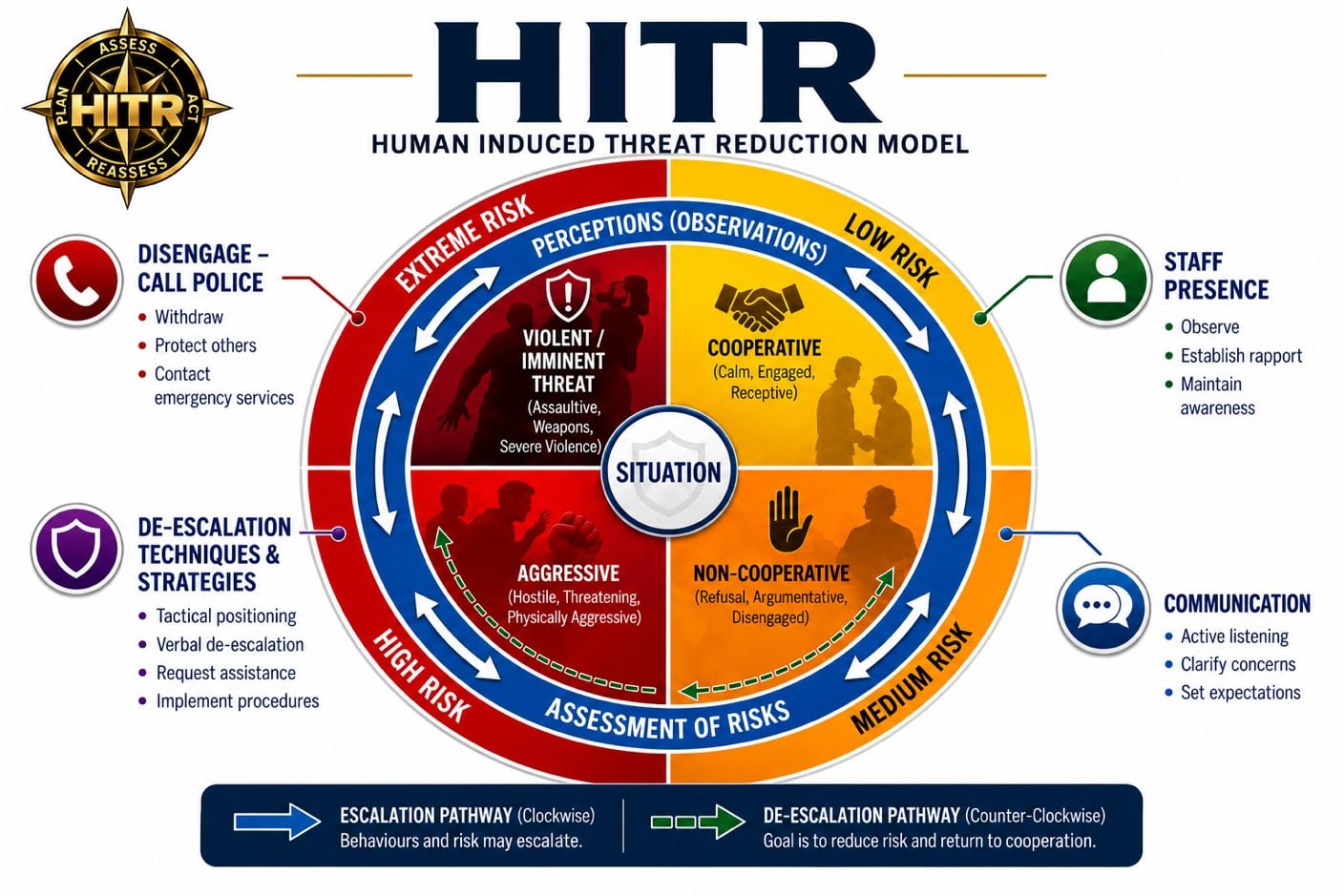
Situation
Everything begins here. What is happening, who is involved, what has changed, and what information is missing?
Assess, Plan, Act
Gather information, develop options, respond, then reassess. The cycle continues until the situation is resolved.
Behaviour categories
Cooperative, non-cooperative, aggressive and violent or imminent threat. Each signals a different level of risk.
Perceptions (Observations)
Experience, fatigue, fear and bias shape what we notice. Two people can see the same event very differently.
Assessment of Risks
How likely is harm, how serious could it be, and what options exist? Communication plays a central role.
Response options
From simple presence to disengagement and police intervention, matched to the level of risk.
Reading Behaviour
Four behavioural categories.
These categories are assessment tools, not labels. They help you describe what you are observing, so you can judge the level of risk and choose a response that matches it.
Cooperative
Engaged, respectful and responsive. Asking questions and working toward a resolution.
Non-Cooperative
Refusing requests, arguing or withdrawing. Risk is rising and more assessment is needed.
Aggressive
Hostile or threatening, invading personal space. Options narrow and intervention matters more.
Violent / Imminent Threat
Harm is happening or about to. Personal safety becomes the first priority.
Escalation pathway
Behaviour can move from cooperative toward violent, sometimes slowly and sometimes very quickly. The aim is to recognize that movement early.
De-escalation pathway
Behaviour can also move back toward cooperation. Good communication and timely intervention are how you help it get there.
Response Options
A response that fits the risk.
The outer ring of the model holds your options. HITR emphasizes choosing the response that is proportional to what you have assessed, and adjusting as the situation changes.
Staff presence
Often the simplest and most effective step. Observe, build rapport and stay aware.
Communication
Listen actively, clarify concerns and set clear expectations.
De-escalation
Reduce emotional intensity, create options and set boundaries.
Disengagement
Recognize when communication is no longer working and create distance.
Police intervention
When the risk is beyond what can be managed safely, call for help.
HITR supports awareness and decision-making. It does not predict violence or guarantee safety. If there is an immediate threat to life or safety, contact emergency services.
Where It Applies
One model, used almost anywhere.
The same process works whether you are walking into a building, leading a team or talking with someone who is upset.

At home
Residential security, and teaching family members to notice what feels off.

At work
Recognizing behavioural change, preventing workplace violence and handling difficult conversations.

In public and while travelling
Noticing exits, choosing your position and preparing before you go.

In your community
Neighbours looking out for one another and speaking up about concerns.
Awareness is not the absence of fear. It is the presence of understanding.
Go deeper with HITR.
Learn the full model, chapter by chapter.
Twenty chapters that take you from the foundations of awareness to threat assessment, de-escalation and everyday habits, with exercises along the way.
Where the HITR concept began.
Glen's five online courses through TBird Security hold the core material HITR was drawn from, written for the same readers as the book.
Books
The HITR library.
Books that bring the principles of Human Induced Threat Reduction to readers at every stage, from young children to adults.
For AdultsNow Available
HITR: A Practical Guide to Situational Awareness, Human Behaviour and Personal Security
The complete HITR Model across 20 chapters. Glen moves from the foundations of awareness and human behaviour to threat assessment, de-escalation, workplace violence prevention and decision-making under pressure, with exercises to test your understanding along the way.
For Teens and Young AdultsComing Soon
HITR: READY
Awareness. Confidence. Safer Choices.
Growing independence brings new experiences, and new situations to navigate.
HITR: READY is a practical guide for high school students, post-secondary students and young adults who are beginning to make more decisions on their own. Walking to school, starting college or university, entering the workforce, travelling, going to social events, meeting new people, or simply spending more time away from home all call for awareness, judgement and good decision-making.
The book introduces the principles of HITR in a practical, approachable way, without creating fear or encouraging readers to see danger everywhere.
Readers learn how to
- Recognize when a situation is changing
- Separate observation from assumption
- Understand behaviour and warning signs
- Manage difficult, aggressive or unpredictable people
- Recognize bullying, manipulation, coercion and boundary testing
- Use time and distance to create options
- Make safer decisions when something does not feel right
- Know when to disengage, leave or seek help
- Build confidence through awareness and preparation
At the centre of the book
The goal isn't to make young people afraid of the world. It's to help them become READY for it.
For Children
The Kinley & Harley Series
A HITR Adventure. Big lessons can begin with small moments.
The Kinley & Harley series introduces children to awareness, confidence, safer decision-making and the importance of talking with trusted adults, all through warm, relatable stories and everyday adventures. Inspired by the principles of HITR, each story helps young readers practise four simple actions.
The goal isn't to make children afraid of the world around them. It's to help them become more observant, confident and comfortable asking for help when something doesn't feel right.
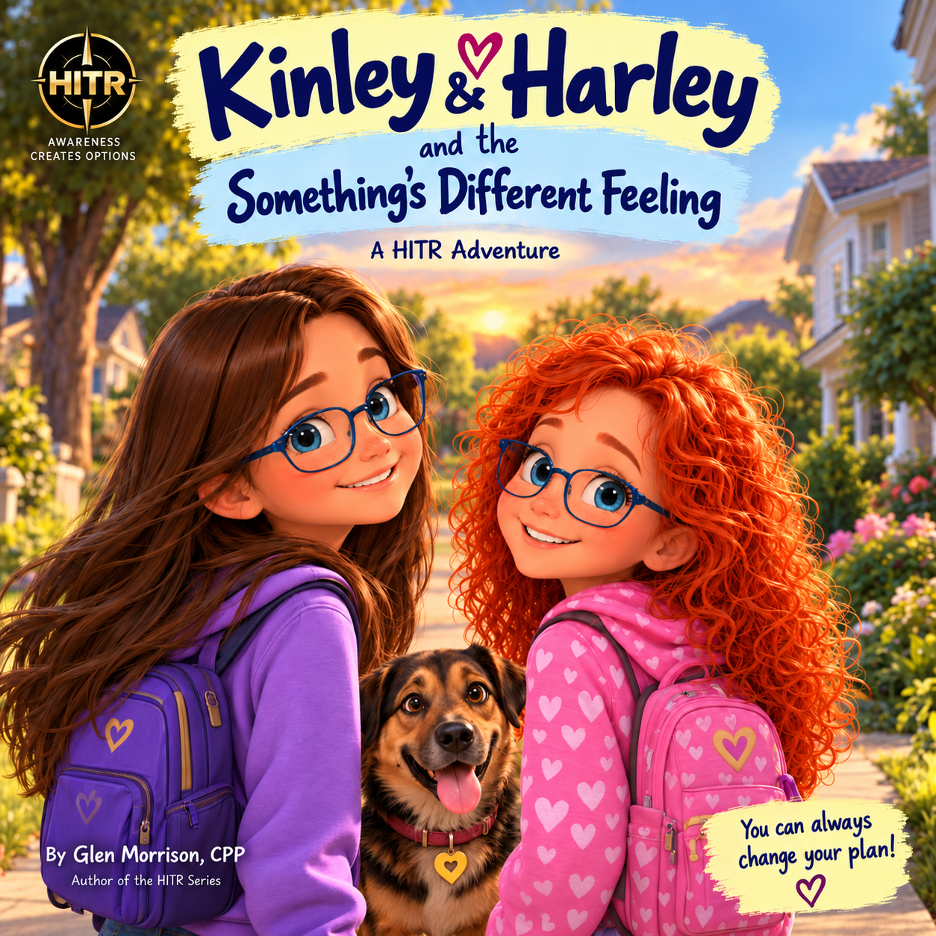
Kinley & Harley and the Something's Different Feeling
Sometimes you can't explain exactly what has changed. You just know that something feels different. When Kinley and her younger sister Harley notice something unusual during an ordinary day, they pay attention, think about their options, make a safer choice and tell a trusted adult. Noticing a change doesn't mean you need to be afraid. It means it's time to pay attention.
Themes: situational awareness, trusting observations, safer choices, talking with trusted adults.
Kinley & Harley and the Bully Who Wouldn't Stop
When someone repeatedly makes Harley uncomfortable and begins treating her badly, Kinley and her friends want to help, but confronting the problem themselves may not be the safest answer. Together, the children learn how to recognize bullying, support one another, create distance when needed and involve trusted adults.
Themes: bullying, friendship, confidence, speaking up, and knowing that asking for help is a strong and sensible choice.
Upcoming Kinley & Harley Adventures
More stories in the series, each built around one HITR lesson.
Kinley & Harley and the Stranger Who Knew Their Names
Someone they don't recognize seems to know more about them than expected. Knowing a child's name doesn't automatically make someone trustworthy, and it's okay to create distance and check with a trusted adult.
HITR lesson: Familiarity isn't the same as trust.
Kinley & Harley and the Shortcut Home
A familiar route home suddenly doesn't feel quite right. The girls must decide whether saving a few minutes is worth ignoring what they've noticed.
HITR lesson: When a situation changes, your plan can change too.
Kinley & Harley and the Secret They Shouldn't Keep
When someone asks them to keep a secret that makes them uncomfortable, Kinley and Harley have an important decision to make.
HITR lesson: Children can always tell a trusted adult about something that worries, frightens or confuses them.
Kinley & Harley Get Lost
A family outing takes an unexpected turn when the girls become separated from the adults. Instead of panicking, they use a simple plan to stay together, find an appropriate helper and get safely back to their family.
HITR lesson: Having a plan before something happens creates options when it does.
Kinley & Harley and the Online Friend
A friendly person online begins asking questions that seem harmless at first. People online may not always be who they say they are, and personal information deserves protection.
HITR lesson: Stop, think and tell before sharing personal information online.
Kinley & Harley and the Big Crowd
At a busy community event, noise, excitement and lots of people make it easy to lose track of family and friends. Meeting points, staying together and paying attention make busy places easier to navigate.
HITR lesson: Preparation creates options.
Helping Children Build Confidence, Not Fear
Children don't need to be frightened to become more safety-aware.
Through stories, conversations and age-appropriate situations, Kinley and Harley help young readers notice what's happening around them, think before reacting, choose safer options and tell someone they trust. Four simple actions that can help build a lifetime of awareness, confidence and better decision-making.